Friday, December 30, 2011

Art Connects Us - Postcard Art History


My motto in teaching and writing about art, including this blog, is 'Art Connects Us.' Art History is a wonderful way to feel the lively embrace of the universal human experience, but if you've ever taken an art history class you probably know that the subject is not ordinarily presented as inclusive. I taught the basic Art History survey course for years so I know well the curriculum of  "See what the Greeks did, thought, made - theirs was a distinct culture completely alien to that of 5th c India, 9th c Americas, 16th c Africa, etc., etc., etc." But there is so much art, so many fascinating cultures, time periods, peoples, artists - and it's all part of the human story.

For me the best approach to art history is to find a common ground in a human idea or concern and then have the fun of exploring the endlessly interesting ways in which culture, climate, geography, available materials, beliefs, and individual imaginations conspire to create distinctive expressions of those basic human ideas and values. 
I teach a university class with this approach - it's a rich experience for my students of widely diverse backgrounds and stimulating for me as the teacher. The broad themes sweep everyone into the discussion so no one has reason to feel excluded or sidelined - we're all part of a continuing tradition of art and human expression. Human figures, animals, beliefs, power, wealth, landscapes, family portraits: the list of possibilities never ends. The human face, for example, holds a place of importance in nearly every culture and time and gives clues to deeply held ideas and values - but hold onto your seats because the differences in expression are astonishing. Every culture and time period chimes in with intriguing forms and layers of meaning.
The goddess Athena's beautiful stone face is a perfect representation of the serene, logical Classical Greeks, but just as representative of its culture is this lovely Gabon Mask, in which geometry forms a vital part of the design, and the chalkiness of the face indicates a spiritual connection. Picasso's wild 'Man in a Hat' would seem madness to the Greeks, as well as to Hans Holbein and the court of Henry VIII, to which this pencil drawing of poet Thomas Wyatt gives us insight, but Modern Art finds in it a fresh creative approach to an old subject. Cindy Sherman's use of her own face as a canvas speaks perhaps all too clearly of a contemporary familiarity with complex ideas of questioning identity. Above all, seated around the table of humanity, the commonality of 'Face,' as in these examples, provides a place to begin a powerful conversation about the meaning of being human.
To expand this work and these ideas I'm offering a series of online Art History 'classes' in the form of postcards - Postcard Art History Each of the series follows a theme in in 10 week subscriptions, with art ranging broadly across cultures, styles, time periods, and artists. Each week you receive a pdf postcard with an image on one side and a brief but solidly informative explanation on the other. Week by week you'll see how cultures and eras interweave and share ideas, values, beliefs. You'll discover differences in the art that work to emphasize commonalities in human experience, and you'll be excited to find new insights and discoveries about art and art history. Themes are fun and intriguing, from 'Supermodels: Glamour Girls of Art History,' 'Gods of All Shapes and Sizes.' 'Happy Families', and others - and I'll be adding new themes regularly.   A Postcard Art History series makes a unique, interesting gift for family and friends,  a good way to catch the interest of children, and a great treat for YOU! If you enjoy my ArtSmartTalk blog I hope you'll support Postcard Art History and recommend it to others. Find all details at www.postcardarthistory.com.

Wednesday, December 14, 2011

Cats, Feasts, and Chardin


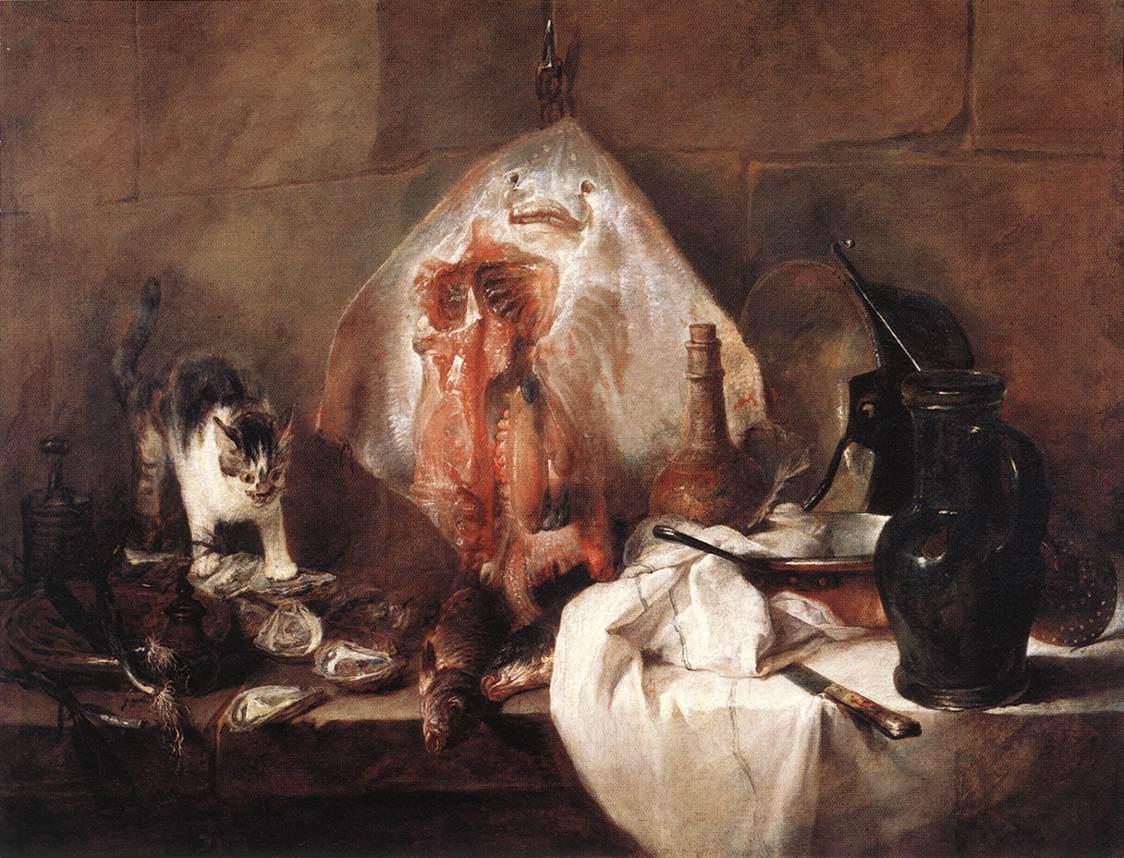
Cats, like children, are hard to include in serious art - too cute. For a change from the modern art of the last two posts, here's some 'serious' historical art that happens to include cats, by one of my favorites.  I like cats - I have two - and I'm very fond of the artist Jean-Baptiste Simeon Chardin (shown here in a self portrait from 1775.) Born in Paris in 1699, Chardin grew up and spent his life within the city walls without much need or thought for travel beyond. Once he caught the attention of King Louis XV he was granted a studio in the Louvre and lived there until his death in 1779. (At the time the Louvre was an abandoned royal residence being used for artisan workshops and meeting places for the artistic and scientific academies founded by Louis XIV - Chardin went regularly to meetings of the arts academy after he became a member.) Chardin was a true local artist, mostly self-taught but smart and observant - and a quiet revolutionary.  In contrast to the grandiose Rococo art that is the signature of the period, Chardin took his cue from the deceptively simple Dutch still life tradition. The golden age of Dutch Baroque painting was drawing to an end, but  masterful examples of composition, virtuosic effects of light and texture, and the rich possibilities of a simple story told with style and close attention to detail would have been easy for Chardin to find. 'Deceptively simple' is a good phrase to keep in mind for Dutch still lifes as well as for the work of Chardin - there is far more than meets the eye. Many Dutch still lifes feature grandiose settings of lavish expensive foods and exquisite vessels of glass, silver, and brass - they do double duty in celebrating the enormous prosperity of Holland during the 17th century, while also paying homage to the simple pleasures of life, free of tyranny by church or king (many contain intricately coded messages, but that's a complicated subject for another post.) The example by Alexander Adriaenssen (at the top), who died shortly before Chardin was born, is somewhat atypical of Dutch still life, but it is a close match for Chardin. The concentration of raw foods anticipate the feast to come, inviting us behind the scenes to identify with the simpler folk who will do the work of preparation - and shoo away the cat lurking around that tempting pile of fresh fish. Chardin's revolution was this peek behind French aristocratic grandiosity, gently (and probably unconsciously - he was no outright rebel) guiding thoughts to a democratic future that would soon slap France hard across its rouged and powdered face. 'The Ray' from 1728 was one of several early paintings that gained him admission to the Academy. I've always found it to be one of his most interesting stories in paint. There are messages here of life and death, cruelty and comfort. Note the cat (really a kitten) - cute at first glance but with the demonic leer of a killer intent on prey, and in contrast the strange 'face' of the eviscerated ray that evokes a sad commedia del arte clown. The knife - an instrument of death - and the pitcher - a container for water, the stuff of life - hover just at the edge of the table, a precarious position that may be there to remind of us the precariousness of existence. 'The Silver Tureen' also by Chardin, also from 1728, also with a cat, seems a meditation on life, with the cat sitting quietly staring into the blank eyes of his fellow creatures , seeming to question the whimsy of fate. And for dog lovers, 'The Buffet.' There are messages here too, but as far as I can tell the dog is just a dog - always hungry and cheerfully optimistic about that pile of food toppling his way.

Wednesday, December 7, 2011

Modern ArtMan: DeKooning at MOMA

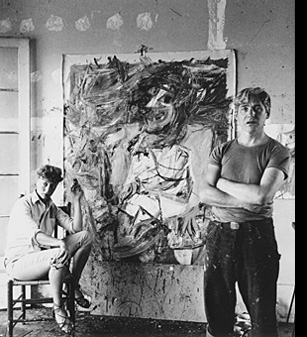
He was a handsome guy, no doubt about it. Even with the 27 cents or whatever it was he had in his pocket when he arrived in New York in 1926, he was going to do something and be somebody - you can see it in the pictures. He paid the requisite art dues for about10 years, working as a sign painter and for the WPA, but by 1935 he was pretty much launched on his career. I doubt, though, if even he knew how important a career that would be. The big retrospective of his work at MOMA - astonishingly, the first major retrospective for him EVER - has been knocking everybody's socks off since it opened on September 18. I certainly concur. It's a fabulous, comprehensive, exhaustive, show, with plenty of 'I never saw that' and 'I didn't know he did that' moments. The first of these comes right at the beginning, with the uncannily accomplished still life he painted when he was a teenage apprentice in his native Rotterdam - it's a 'life's not fair' moment, in a category with the portrait Picasso did at a similar age and young Leonardo da Vinci's angel, so beautifully painted that ever after his master Verrochio (allegedly) devoted himself exclusively to sculpture. The de Kooning of the iconic Woman series is present almost immediately by the fierce sense of energy that pervades his work in all mediums, though he worked his way through several influences and experiments with style. I found the first true 'de Kooning' appearing around 1939 with 'Figure,' a small framed study that looks backward to the elegance and form of Renaissance portraits while also sounding a loud call to the colorful, fractured expression of mid-20th century America art. Arshile Gorky was clearly important for de Kooning; they were exact contemporaries and shared a studio for a while, probably finding comfort in their common status as uprooted Europeans as well as support for their brave adventures in modern art. I saw a lot of Gorky in de Kooning, even in later paintings, no doubt helped along by the recent Gorky exhibition at the Pennsylvania Museum of Art. Both of them had a way with color that was distinctive, aggressively appealing, even jarring, with a kind of exaggerated sweet palette of pinks, greens, and blues. Cezanne's mastery of color came to mind too; de Kooning had as sure a touch with his particular combinations as Cezanne had with his, though de Kooning's are atonal, minor chords compared to Cezanne's deep resonant harmonies. Having said that, I loved his black and white drawings from the 1940's where line and form, splashed and swirled with the same dashing, confident energy, took precedence over color. Gallery after gallery is full of exciting, pulsing shapes and movement; it's like he had a big stew of shapes and ideas constantly on the boil, and he kept stirring it up and pulling out new ways to use the ingredients. The bulbous, throbbing shapes of recognizable limbs and bodies morph into abstract shapes in the drawings, then into more figures, and into his iconic women with their sharp little grinning mouths. One wall is hung with 5 of the Women series, a wonderful intellectual and aesthetic gauntlet. So much has been written about these blowsy, powerful females, much of it stuck on descriptions involving 'angry' or 'frightening.' In my opinion they're rich, somewhat comical, strong, assertive, and assured - they may be aggressive, but why shouldn't they be? De Kooning was looking squarely forward by that time - it's not the old days anymore. At least that's what I like to think, despite knowing that he wasn't always so nice to his flesh and blood wife and fellow painter, Elaine de Kooning. Her portrait in the show is a counterpoint to the Women series on several levels. Calm, subdued, done with virtuoso drawing skill and carefully focused on every detail of her face, it could be an 18th century portrait by Jean-Dominique Ingres. The exhibit continues through the last phases of de Kooning's life and career, encompassing a period of pure abstraction and on, into the years when he suffered from Alzheimer's before his death in 1997. Somewhere in the 70's, although the energy and pure panache with paint and surface never flagged, as evidenced by a gallery full of bravura abstractions, the center started to disappear. In the last years it finally slipped away completely, leaving only the untethered ribbons of those sad late paintings. De Kooning is the acknowledged start to 'Abstract Expressionism,' the movement that dominated art during the middle years of the 20th century and changed everything that came after - the MOMA retrospective is the celebration of one of the greatest contributors to the story of Modern Art.
Exhibition images courtesy of www.moma.org

More about De Kooning: A Retrospective
http://www.moma.org/interactives/exhibitions/2011/dekooning/
http://www.npr.org/2011/12/05/143134807/at-moma-a-look-at-de-koonings-shifts-in-style